
Showing posts with label animal rights. Show all posts
Showing posts with label animal rights. Show all posts
Tuesday, March 19, 2013

Thursday, November 8, 2012
Have a Compassionate Holiday: Save a Turkey
Click on this link

Do a turkey a favor and have a vegetarian or vegan holiday celebration. For ethical and health reasons, vegetarians don't eat animals, including beef, poultry, pork, lamb, and fish). In addition to meat, vegans don't eat animal products like milk, eggs, and cheese, or any foods that contain these ingredients.
A plant-based vegan feast will do far less damage nutritionally than the traditional Thanksgiving meat-based meal, as it cuts out a good deal of fat, sodium and all of the cholesterol, since cholesterol is found only in animal foods. Best of all, serving a cruelty-free holiday dinner will honor the animals customarily used as ingredients - a gentler way to gather with loved ones in the spirit of giving thanks for our lives, health, and happiness.
Here are some tips to avoid ruffling feathers this holiday:
- Try a delicious "faux" turkey by checking out Gardien, Quorn, and Tofurkey products in your store's freezer section. Alternatively, update your main dish style with a stuffed squash, legume (beans, lentils), or nut roast.
- Make holiday gravy and stuffing using vegetable broth instead of meat-based broth.
- Soy and coconut milk (unsweetened) are great swaps for milk in your soup, mashed potato, pumpkin pie filling, cookie, and other baked goods recipes.
- Replace butter with margarine (Earth Balance has buttery spread and shortening versions) and eggs with egg replacer for your cooking and baking.
- Search online for seasonal recipes that offer compassionate alternatives to the conventional turkey dinner. You can find recipes for all your faves, including soups, breads, vegan stuffing, candied yams, cranberry sauce, and pumpkin and pecan pies - or simply "vegetarian holidays."
Twenty-five years ago, Farm Sanctuary, an organization that rescues mistreated, abused, and neglected farm animals, challenged the traditional Thanksgiving dinner with an event that celebrated and cultivated kindness, encouraging people to "adopt" turkeys instead of eating them. This "first Thanksgiving" has grown into an organized movement in which sponsorships help them rescue animals and provide care for them at their sanctuaries, as well as educate and advocate for farm animals everywhere.
Ellen DeGeneres, the national spokesperson for the project for the second year in a row shares,
"Did you know that every year between 250 and 300 million turkeys are bred for slaughter in the United States? More than 46 million for Thanksgiving alone. So, this Thanksgiving, instead of eating a turkey please join me in adopting one, from Farm Sanctuary's Adopt-A-Turkey Project and you can give a turkey something to be thankful for."To save even more lives this year, you can adopt a turkey with a donation gift of $30 by visiting adoptaturkey.org or calling the Turkey Adoption Hotline at 1-888-SPONSOR. You will receive a certificate with a photo and details on your new turkey beneficiary. And for the ultimate cool, original holiday gift of compassion, you can adopt farm animals for your loved ones and yourself, including cows, pigs, goats, sheep, ducks, geese, turkeys, and chickens by visiting farmsanctuary.org/get_involved/aafa, email sponsorship@farmsanctuary.org, or phone 607-583-225 ext 225. Visit your new adoptee at the Watkins Glen, NY, or Orland, CA, shelters on your next vacation.

Thursday, October 25, 2012
Help protect the Gray Wolf

A large, tawny gray wolf (Canis lupus) that formerly
occupied diverse habitats throughout northern North America and Eurasia but now
lives in fewer, more limited areas because of human encroachment. Also called
timber wolf.
The gray wolf is the smallest subspecies and most edangered . In North America, the largest gray wolf is found in Alaska and western Canada and the smallest is found in Mexico. They weigh 50 to 90 pounds. The wolf is 4 ft. long and has a tail about 1ft. 3 inches long. Their coats can vary from black, gray, to white. The underparts and legs are a yellowish white.
Wolves can travel for hours and can run up to 20mph. The alpha wolves are dominant and generally the mother and father of the pack. The alpha wolves eat first, but the other members of the pack try to steal the food before their turn. The gray wolf is a predator of larger animals than itself, like deer, moose, and elk.
Gray wolves have strong family ties. They often mate for life. The female wolf has four to six cubs in April or May. The cubs are born after two months. We can only guess about the behavior of the wolf because humans destroy their habitat.
In 1973, the gray wolf was on the endangered species list in the U.S.A. The government said to kill the wolves. But, when the wolves went on the endangered species list the government had to change their plan.
Some reasons why the gray wolf is endangered is because they are misunderstood. A long time ago, people paid hunters to kill the wolves. This is called a bounty. The bounty lasted until 1967. 55,000 wolves killed each year between 1870 and 1877. Hunters shot them. They poisoned the wolves with strychnine and they also poisoned them with a poison compound 10 80 1080. The hunters trapped the wolves. The wolves were trapped and hunters infected them with mange which the wolf would bring back to destroy the pack later. The hunters would capture the wolves and put ropes around each of the wolves legs then pulled them off one at a time and watched them die a slow and painful death.
We can help the gray wolf by trying to understand them better. We can also help them by trying not to shoot them and not destroying their habitat. The wolves are part of the ecological system and what would happen if they weren't here?
No Reprieve in the Rockies
One year after feds strip protections, states go all-out against wolves
May marked a year since Congress made the unprecedented political move of stripping Endangered Species Act protections from wolves in the Northern Rockies—leaving Idaho and Montana in charge of managing wolves in their states. The result: Hundreds of wolves have been hunted, trapped and aerial-gunned in an aggressive attempt to undo one of conservation’s greatest success stories.In just a year, Idaho cut its wolf population by about 40 percent, to 600 or fewer. Under the state’s plan, which was approved by the U.S. Fish and Wildlife Service, Idaho has permission to lower the number of wolves to fewer than 200.“It’s as though Idaho has been transported back to the 1890s—to a time when wolves were aggressively targeted for eradication,” says Suzanne Stone, Defenders’ Rocky Mountain representative. “These extreme wolf-killing policies have no place in modern-day wildlife management.” Idaho is now planning to more than double the number of wolves—to 12—that a single hunter can take in the upcoming 2012-2013 hunting season.
THANK YOU!
Defenders supporters sent more than 150,000 messages to Idaho Gov. Butch Otter, Congress and Interior Secretary Ken Salazar asking them to stop Idaho’s extreme anti-wolf policies. A big shout out to all those who spoke out on the wolf’s behalf.
Meanwhile, Montana lost more than a third of its wolf population since May, with Reuters reporting about 260 wolves killed. State officials are now moving toward an aggressive anti-wolf policy similar to Idaho’s. At press time, the Montana Fish, Wildlife and Parks Commission approved a fall hunt that would eliminate quotas in nearly all hunting districts, extend the hunting season by two months into the breeding season, allow wolf trapping for the first time and permit the use of electronic calls—something that is generally not allowed for other game species. Defenders supporters sent more than 150,000 messages to Idaho Gov. Butch Otter, Congress and Interior Secretary Ken Salazar asking them to stop Idaho’s extreme anti-wolf policies. A big shout out to all those who spoke out on the wolf’s behalf.
“Caving to political pressure, Montana is basing its decision on anti-wolf rhetoric rather than science,” says Stone. “There is no justification for state officials to abandon what was once a more measured approach to wolf management. Livestock losses are at a five-year low and elk populations are above population objectives in the majority of the state.”
In Wyoming, home to about 328 wolves, federal protections have not yet been removed. But assuming they will be by fall, Wyoming officials have proposed allowing hunters to kill up to 52 wolves in a trophy game area adjacent to Yellowstone National Park. More than 30 wolves are in a zone where they can be shot on sight without a hunting license. That means about 30 percent of the wolves outside of Yellowstone are likely to be killed later this year if federal delisting of wolves in Wyoming moves forward. Their fate now rests in the hands of the Obama administration.
The wolf-kill mentality comes mostly from anti-predator residents who care more about protecting livestock and having easy hunting opportunities than safeguarding native species. But conservationists and biologists credit wolves, along with grizzlies, for helping to restore balance to an ecosystem that had been out of whack for decades because of artificially inflated elk herds, which overgrazed native vegetation.
In fact, the loss of major predators in forest ecosystems and the resulting explosion of large herbivores cripples the growth of young trees, causing stream bank erosion and reducing biodiversity by harming fisheries and other wildlife, according to a recently published Oregon State University report reviewing 42 scientific studies done over the last 50 years.
“Wolves are part of America’s wildlife heritage and play a vital role in maintaining a healthy environment,” says Clark. “States should be managing for robust, sustainable populations, not the absolute bare minimum to keep the species from going extinct. The American people made an investment in wolf recovery that continues to pay dividends in the form of tourism dollars and healthier landscapes. Studies have shown that wolf tourism brings in millions of dollars every year to the Yellowstone region. We should be building on that investment instead of undermining it.”
See personalized photos of hundreds of Defenders’ passionate and creative wolf supporters—and add your own—at www.defenders.org/wolfweek.
Tuesday, October 23, 2012
What Binti Jua Knew
By Barbara J. King
Friday, August 15, 2008
 A toddler falls over a railing, 24 feet down, into the gorilla enclosure of
the Brookfield Zoo outside Chicago. There he lies, unconscious, among seven
apes, some with poundage and power exceeding that of an adult man. As one of
them approaches the boy, onlookers tense.
A toddler falls over a railing, 24 feet down, into the gorilla enclosure of
the Brookfield Zoo outside Chicago. There he lies, unconscious, among seven
apes, some with poundage and power exceeding that of an adult man. As one of
them approaches the boy, onlookers tense.
But Binti Jua, an 8-year-old female gorilla, picks up the boy, and, carrying
him along with her own infant, gently hands him over to zoo staff.
This stunning event in 1996 earned Binti Jua global headlines (and can be seen, if in grainy video, on YouTube). It was an incident that no one who witnessed it -- in person or online -- could forget. But there was nothing about Binti Jua, or any of the chimpanzees, bonobos, gorillas or orangutans that exhibit reasoning and empathy, in Russell Paul La Valle's July 27 op-ed, " Why They're Human Rights."
La Valle argued that the Spanish Parliament should not award human rights to apes, as it is considering. He opened with a throwaway line about monkeys in the circus -- and made his first mistake. First of all, monkeys' bodies are smaller than those of apes, their thinking is less complex and they are more distantly related to humans. But a far more serious error was La Valle's assertion that apes are "irrational, amoral."
In an echo of 17th-century philosopher Rene Descartes' dualism, La Valle invoked a strict dividing line between humans, who reason, and animals that rely on "instinctual, inherited knowledge of how to survive." It's clear that La Valle hasn't spent much time with apes lately -- or looking into any of the major findings by primate scientists over the past two or three decades. In expressing reasoning and empathy, Binti Jua was not unique; nor was her behavior an artifact of zoo life. Wild chimpanzees plan ahead and carry tools to work sites, where they crack open hard-shelled nuts with wood and stone hammers. They choose sides thoughtfully in ongoing competitions for status and reward friends' loyalties while exacting revenge on their enemies. When close companions suffer wounds or injuries, wild chimpanzees groom and care for them.
(This compassion by chimpanzees, it must be said, is at times matched by their outright cruelty to each other. What species does that remind you of?)
Captive orangutans modify their own gestures according to how much a human companion seems to comprehend their requests. Bonobos use a symbol-laden computer keyboard to discuss with their caretakers plans for the day, as well as to make promises about being "good."
The apes that I have described, and many more that my fellow primatologists write about, are neither irrational nor amoral. The zoologist and ethologist Frans de Waal has argued that the origins of morality can be found in our primate cousins, and my own anthropological work suggests that the evolutionary roots of today's human religiosity can be found in the ape world.
It's important to correct La Valle's misunderstanding of apes, but not because I'm a fervent supporter of legalizing rights for animals. The question is complex and arguable: whether to award rights to apes or to assume responsibility for apes' welfare. But while writers such as La Valle bandy words about and academics such as I discuss the philosophical aspects of rights, the great apes are dying.
The combined forces of poaching, diseases such as ebola fever, habitat destruction and the trade in bushmeat are killing off the apes at unprecedented rates. If we write them off as irrational and amoral animals, we will fail to grasp the depth of their suffering at the hands of our own species -- a suffering that is cognitive and emotional as well as physical.
Barbara J. King is a professor of anthropology at the College of William and Mary and is the author of "Evolving God: A Provocative View on the Origins of Religion."
This stunning event in 1996 earned Binti Jua global headlines (and can be seen, if in grainy video, on YouTube). It was an incident that no one who witnessed it -- in person or online -- could forget. But there was nothing about Binti Jua, or any of the chimpanzees, bonobos, gorillas or orangutans that exhibit reasoning and empathy, in Russell Paul La Valle's July 27 op-ed, " Why They're Human Rights."
La Valle argued that the Spanish Parliament should not award human rights to apes, as it is considering. He opened with a throwaway line about monkeys in the circus -- and made his first mistake. First of all, monkeys' bodies are smaller than those of apes, their thinking is less complex and they are more distantly related to humans. But a far more serious error was La Valle's assertion that apes are "irrational, amoral."
In an echo of 17th-century philosopher Rene Descartes' dualism, La Valle invoked a strict dividing line between humans, who reason, and animals that rely on "instinctual, inherited knowledge of how to survive." It's clear that La Valle hasn't spent much time with apes lately -- or looking into any of the major findings by primate scientists over the past two or three decades. In expressing reasoning and empathy, Binti Jua was not unique; nor was her behavior an artifact of zoo life. Wild chimpanzees plan ahead and carry tools to work sites, where they crack open hard-shelled nuts with wood and stone hammers. They choose sides thoughtfully in ongoing competitions for status and reward friends' loyalties while exacting revenge on their enemies. When close companions suffer wounds or injuries, wild chimpanzees groom and care for them.
(This compassion by chimpanzees, it must be said, is at times matched by their outright cruelty to each other. What species does that remind you of?)
Captive orangutans modify their own gestures according to how much a human companion seems to comprehend their requests. Bonobos use a symbol-laden computer keyboard to discuss with their caretakers plans for the day, as well as to make promises about being "good."
The apes that I have described, and many more that my fellow primatologists write about, are neither irrational nor amoral. The zoologist and ethologist Frans de Waal has argued that the origins of morality can be found in our primate cousins, and my own anthropological work suggests that the evolutionary roots of today's human religiosity can be found in the ape world.
It's important to correct La Valle's misunderstanding of apes, but not because I'm a fervent supporter of legalizing rights for animals. The question is complex and arguable: whether to award rights to apes or to assume responsibility for apes' welfare. But while writers such as La Valle bandy words about and academics such as I discuss the philosophical aspects of rights, the great apes are dying.
The combined forces of poaching, diseases such as ebola fever, habitat destruction and the trade in bushmeat are killing off the apes at unprecedented rates. If we write them off as irrational and amoral animals, we will fail to grasp the depth of their suffering at the hands of our own species -- a suffering that is cognitive and emotional as well as physical.
Barbara J. King is a professor of anthropology at the College of William and Mary and is the author of "Evolving God: A Provocative View on the Origins of Religion."
Friday, September 21, 2012
Thandi the Rhino - 6 Months later

On the 2nd of March 2012 one cow and two bull rhino’s were poached at Kariega Game Reserve. Tragically, one bull was fatally wounded and died during the course of the night, whilst the remaining two were severely injured, but showed an incredible will to survive.
For 24 days wildlife veterinary expert, Doctor William Fowlds, worked tirelessly with the Kariega team to give these survivors the best possible care and chance for recovery. Their bravery was unbelievable, and inspired our rangers to nickname them Thandiswa and Themba, two Xhosa names meaning courage and hope.
Sadly Themba (HOPE) suffered a leg injury on the night he was poached and as a result of infection passed away on the morning of the 26 of March 2012.
Six months after their brutal attack, Thandi continues to inspire and amaze us with her incredible fighting strength and miraculous recovery.
Wednesday, August 1, 2012
Pit Bulls Saved By $1 Million Grant From PetSmart Charities
 by Sharon Seltzer - July 31, 2012 - 3:44 pm
PetSmart Charities is doing their part to stop overcrowding in animal shelters and the senseless killing of two of the most euthanized pets across the country. They have awarded $1 million in grants for a nationwide spay and neuter campaign for pit bulls and cats.
The campaign called “Primp Your Pit” is being offered during August at 63 non-profit spay and neuter clinics in 30 states. The goal is to sterilize 6,750 pit bulls during the month.
The grant program, which hopes to reduce overcrowding in city animal shelters, offers spay and neuter surgeries for a special rate of $20, including a free nail trim.
PetSmart Charities reports that 35 percent of cats and dogs in U.S. households are not spayed or neutered. “Pit bulls, in particular, end up in shelters in large numbers due to the myths and negative media and public perceptions that are associated with the breed.”
“Our national grant program gives much-needed help to pit bull terriers that are especially at risk,” said Susana Della Maddalena, executive director of PetSmart Charities, Inc. “Through the ‘Primp Your Pit’ promotion and our ongoing efforts to make affordable spay/neuter surgeries available to the public, pet parents can prevent unwanted litters and ensure their pet lives a long, happy life.
Each year approximately 8 million pets end up in shelters and 4 million of them – about 11,000 a day – are euthanized. Many become homeless as a result of accidental litters from parents that are not fixed.
In February the grant program ran another campaign to sterilize cats, called “Beat the Heat.” It tried to spay and neuter cats before “kitten season” began in the spring. The effort was very successful and spayed and neutered 17,000 cats in one month.
Participating “Primp Your Pit” clinics are listed on the PetSmart Charities website.
PetSmart Charities was established in 1994 as a non-profit organization to create and support programs that save the lives of homeless pets, raise awareness of companion animal welfare issues and promote healthy relationships between people and pets.
Friday, July 20, 2012
A dog named Faith
This
dog was born on
Christmas Eve in the year 2002. He was born
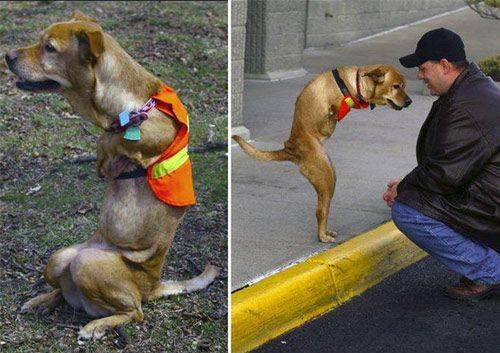
with 2 legs
-
He of course could not walk when he was born. Even his mother did not want him.
He of course could not walk when he was born. Even his mother did not want him.

His first owner also did not think that he could
survive and he was thinking of 'putting him to sleep'.
But then, his present owner, Jude Stringfellow, met him and wanted to take care of him.
She became determined to teach and train this little dog to walk by himself.
She named him 'Faith'.
But then, his present owner, Jude Stringfellow, met him and wanted to take care of him.
She became determined to teach and train this little dog to walk by himself.
She named him 'Faith'.

In the beginning, she put Faith on a surfboard to let
him feel the movement.
Later she used peanut butter on a spoon as a lure and reward for him for standing up and jumping around.
Even the other dog at home encouraged him to walk.
Amazingly, only after 6 months, like a miracle,
Faith learned to balance on his hind legs and to jump to move forward.
After further training in the snow, he could now walk like a human being.
Later she used peanut butter on a spoon as a lure and reward for him for standing up and jumping around.
Even the other dog at home encouraged him to walk.
Amazingly, only after 6 months, like a miracle,
Faith learned to balance on his hind legs and to jump to move forward.
After further training in the snow, he could now walk like a human being.

Faith
loves to walk
around now.
No matter where he goes, he attracts people to
him. He is fast becoming famous on the international scene and
has appeared on various newspapers and TV shows.
There is now a book entitled 'With a Little Faith' being published about him.
He was even considered to appear in one of Harry Potter movies.

His present owner Jude Stringfellew has given up her teaching post and plans to
take him around the world
to preach that even without a perfect body, one can have a perfect soul'.
to preach that even without a perfect body, one can have a perfect soul'.



In
life there are
always undesirable things, so in order to feel better you just need to look at
life from another direction.
I hope this message will bring fresh new ways of thinking to everyone and that everyone will appreciate and be thankful for each beautiful day.
Faith is the continual demonstration of the strength and wonder of life.
Thursday, July 12, 2012
Chloe, dog set on fire in Philadelphia, has died

UPDATE 6/26/12: - Some of you have asked how you can contribute to the reward fund for Chloe. If you would like to do so by phone, please call Lois at (215) 426-6300, ext. 217, on their website, or by sending a check to the PSPCA, 350 E. Erie Ave., Philadelphia. PA 19134. Be sure to indicate that this donation is to go toward the reward money for Chloe.
Through tears, I write the heartbreaking news that Chloe, the dog who was deliberately set on fire in Philadelphia this weekend, has died from her injuries.
This comes from The Pennsylvania SPCA, who received word at about 9:35 p.m. tonight that Chloe died about an hour after being transferred to rescue for intensive care of her injuries.
Despite the valiant efforts by the PSPCA veterinary staff and Animal Alliance of NJ, Chloe was in great pain.
The PSPCA Humane Law Enforcement officers are still searching for the monster who did this to a defenseless dog. If you have any information, you are urged to call the PSPCA’s anti-cruelty hotline at (866) 601-SPCA. A $500 reward is being offered for the arrest of this sick individual.
Read the original story here, posted earlier today.
Rest in peace, sweet Chloe. So sorry your life had to end with such pain and suffering, but now you are free.
A day for Hope
Georgia, Monterion Dionte Davis pleaded guilty in front of the judge and jurors today before the trial of Hope could start. The evidence was so overwhelming Davis pleaded guilty on all counts of animal abuse.
The sentence was handed down, 5 years with a minimum of 2 years to be served, and Davis is not allowed to be around animals, Davis was led out of the Court in Handcuffs.
Davis was arrested July of last year after authorities investigated a dog that was brought in to a animal shelter that had nearly been decapitated.
Monroe County Sheriff John Cary Bittick said that this was the worst case of animal abuse he'd seen in his 29 years as sheriff.
Bittick said good detective work led them to Davis. He said Davis admitted to using an electrical cord to tie the dog now named Hope in the woods. The sheriff's office said Davis told investigators he left the dog to die.

The story of Hope
On July 7th 2011 Shane and his wife Janet Smith went to the local Shelter because Janet would rescue dogs for an animal advocacy group. Shane Smith stated “we went up to the kennels and I saw a dog sitting in the back of one of the stalls with a wire around her neck. She walked up to Janet and I and then sat back down because she was so weak.”
“I told Janet we were not leaving without that dog.” Smith went on to state “Janet called the president of the rescue group and was told, as I don’t ask for much, I can take her, but with the understanding that the rescue group’s regular donors were not to be asked for money to help the dog. Then the president said she would make the first donation to help.”
“Janet and I gently put her in the car and headed to the Caldwell Veterinary Hospital . On the way, Janet said we could name her Faith or Hope. I thought Hope was a perfect name. The veterinary staff was waiting for Hope when we arrived. The surgery to repair the damage to Hope’s neck was performed that night."
Dr. Butler Caldwell who preformed Hopes emergency surgery was amazed she was still alive.
"Most of the musculature in her neck and the trachea had been severed," said Dr. Caldwell. "Fortunately, the major arteries were not severed or the esophagus."
On July 26th of 2011 Hope took her last breath.
Smith stated “for 19 days we worked so hard from morning until past midnight to try to help her. I stayed with Hope until she was at peace. Hope’s urn is at home with us, where it will stay.”
Shane and Janet Smith made a promise to Hope before she died that they would find justice for her, and that is exactly what they did today.
Animal abusers that end up in court are rarely given prison sentences; most are given a fine and sent out to abuse again.
This was a day for Hope.
Also see:
http://www.cbsatlanta.com/story/15394345/dog-nearly-decapitated-inspires-organization-to-save-more-animals
https://www.facebook.com/#!/pages/Paws-for-HOPE-and-Faith/262968893737541
Hope The Dog Tortured With Blade, Had Mouth Taped Shut

The Huffington Post | By Andy Campbell Posted: 07/11/2012 4:35 pm Updated: 07/11/2012 4:41 pm
She was left on the side of the road with gashes up to five inches long covering her body. Her mouth was bound with electrical tape, causing her exposed tongue to swell. She was unable to eat, drink or pant for more than a day.
Miraculously, Hope the dog survived her horrific injuries and is recovering in a Texas veterinary clinic.
Now authorities need help finding her tormentor.
A compassionate citizen called Parker County Sheriff's deputies on Monday morning to report that an injured dog was wandering the streets near Weatherford, according to the sheriff's press release.
Animal control workers arrived to find the 3-year-old pug-mix breed stumbling, frightened and severely wounded.
Upon further inspection, they found that Hope's attacker had purposefully pulled her tongue out and taped her mouth shut. Her tongue grew to such an enormous size and sustained so much damage, vets almost needed to amputate it. The torturer also left five deep, bloody gashes on her body with some kind of blade, KTBC reported. It took 100 stitches to close all her wounds.
In Memory Of Lennox, Dog Put To Death For Resembling A Pit Bull
A determined 22-month long legal battle and a heartfelt social-media campaign for Lennox the dog came to a sad end on Wednesday. The 7-year-old dog was euthanized in Northern Ireland because his appearance resembled a pit bull terrier, a breed that is banned in the country.

A statement from the Belfast City Council said it had humanely destroyed “one of the most unpredictable and dangerous dogs” that its appointed expert had ever come across. The council said they carried out the court-ordered euthanasia for reasons of public safety and “a sustained campaign of abuse” against city officials from protestors.
Lennox’s story began two years ago when he was taken into custody because he looked like a pit bull dog. Pit bulls and pit bull mixes are outlawed in Britain.
Caroline Barnes, who owned Lennox, testified in court that her dog was a bull dog mix, not a pit bull terrier and that he had never bitten anyone. She asked the court to let her move Lennox outside of Northern Ireland in an area that did not have breed specific legislation. She wanted Lennox to come to a sanctuary in the United States.
News of Lennox’s case launched a massive online campaign by animal lovers in Britain and the U.S. to save the dog’s life. The commitment of tens of thousands of “Save Lennox” fans, LennoxArmy followers and Care2 petitioners continued during the entire 22-months he was imprisoned.
Barnes fought for her dog’s life in the court system until the very end. After nearly two years, Lennox’s fate was determined last month when an appeal was dismissed by Northern Ireland’s senior judges. The judges upheld two 2011 rulings to have Lennox euthanized.
Meanwhile Lennox endured the time at a municipal animal shelter in Belfast where employees claimed he was becoming more aggressive and unpredictable.
Councilman Pat McCarthy said, “The people looking after Lennox for the past two years said that one minute the dog was placid and friendly, and the next he would try to get through the fence to get at you.”
Perhaps Lennox was getting as frustrated with the legal process as the humans fighting for his life.
Victoria Stilwell, host of Animal Planet’s “It’s Me Or the Dog,” said “I hoped Belfast City Council would realize that there were alternatives that provided a sanctuary for Lennox in the USA where he would be safe, but they did not listen.”
On the final day Caroline Barnes and Lennox were refused the last shred of humanity that could have been given; Barnes was not allowed to be with her dog when he died.
A Facebook page for Lennox gave an “official statement” from the family: "We have been denied the opportunity to say goodbye. We have also been told that we cannot collect his body and bring Len home. We have been informed, however, that we will receive "some" ashes in the mail."
Rest In Peace, Lennox.


Thursday, May 10, 2012
Puppy with horrific injuries discovered along road in Texas
Published on May 9, 2012
Link to article http://www.examiner.com/article/puppy-with-horrific-injuries-discovered-along-road-texas
 Sometimes bad things happen to good dogs. Thankfully, sometimes those victimized dogs are discovered, and helped, by good people. A puppy named Bubba has encountered both.
According to Karen Holland, Rescue Director of Chance's Haven, 6-month-old Bubba was discovered along Main Street in Everman, Texas on May 5.
Sometimes bad things happen to good dogs. Thankfully, sometimes those victimized dogs are discovered, and helped, by good people. A puppy named Bubba has encountered both.
According to Karen Holland, Rescue Director of Chance's Haven, 6-month-old Bubba was discovered along Main Street in Everman, Texas on May 5.
Gilbert Salas, the animal control officer who discovered the puppy, quickly realized that something was terribly wrong and whisked the puppy to an emergency veterinary clinic. Here, Salas learned the horrible truth about what this puppy had endured.
According to the veterinarian, Bubba's wounds, which include a broken hip, three fractures to his rear legs and multiple bite wounds, are consistent with those of a bait dog.
It is believed that Bubba's legs were intentionally broken in order to render him immobile, making it easier for other dogs to attack him. Bubba's injuries were so severe that the emergency veterinarian recommended euthanasia.
But Bubba's story did not end at the clinic. Thankfully, his last moments alive were not shrouded by violence and unimaginable pain.
Instead, Chance's Haven, a 501(c)3 organization, was contacted and the rescue agreed to take on Bubba; despite the knowledge that doing so would come at a huge expense.
Yesterday, Bubba underwent surgery for his multiple fractures at an orthopedic specialist in Pilot Point, Texas. He is currently sporting multiple plates and screws in his legs, but overall, his prognosis is good.
 Those who have learned about Bubba's horrific ordeal have been following his story closely on Facebook. Dozens have already contributed funds to help the rescue organization pay for Bubba's extensive surgery.
Unfortunately, though the amount raised so far is admirable, it falls short by thousands. Bubba has a long road ahead of him thanks to the cruelty of individuals mired in the ugly world of dog-fighting. Thankfully, he has landed in the arms of compassionate people who are working hard to undo the considerable wrongs that he has been forced to endure in his short life.
If you are interested in making a contribution towards Bubba's care, please click here.
Link to article http://www.examiner.com/article/puppy-with-horrific-injuries-discovered-along-road-texas
 Sometimes bad things happen to good dogs. Thankfully, sometimes those victimized dogs are discovered, and helped, by good people. A puppy named Bubba has encountered both.
Gilbert Salas, the animal control officer who discovered the puppy, quickly realized that something was terribly wrong and whisked the puppy to an emergency veterinary clinic. Here, Salas learned the horrible truth about what this puppy had endured.
According to the veterinarian, Bubba's wounds, which include a broken hip, three fractures to his rear legs and multiple bite wounds, are consistent with those of a bait dog.
It is believed that Bubba's legs were intentionally broken in order to render him immobile, making it easier for other dogs to attack him. Bubba's injuries were so severe that the emergency veterinarian recommended euthanasia.
But Bubba's story did not end at the clinic. Thankfully, his last moments alive were not shrouded by violence and unimaginable pain.
Instead, Chance's Haven, a 501(c)3 organization, was contacted and the rescue agreed to take on Bubba; despite the knowledge that doing so would come at a huge expense.
Yesterday, Bubba underwent surgery for his multiple fractures at an orthopedic specialist in Pilot Point, Texas. He is currently sporting multiple plates and screws in his legs, but overall, his prognosis is good.
 Those who have learned about Bubba's horrific ordeal have been following his story closely on Facebook. Dozens have already contributed funds to help the rescue organization pay for Bubba's extensive surgery.
 Unfortunately, though the amount raised so far is admirable, it falls short by thousands. Bubba has a long road ahead of him thanks to the cruelty of individuals mired in the ugly world of dog-fighting. Thankfully, he has landed in the arms of compassionate people who are working hard to undo the considerable wrongs that he has been forced to endure in his short life.
If you are interested in making a contribution towards Bubba's care, please click here.
Maryland Declares All Pit Bulls ‘Inherently Dangerous’
May 8, 2012
 Last week, the Maryland Court of Appeals officially declared all pit bull-type dogs as “inherently dangerous.” As a result, owners are now more likely to forcibly give up their dogs.
Some feel this is a grave mistake and will have negative effects in the animal community.
Last week, the Maryland Court of Appeals officially declared all pit bull-type dogs as “inherently dangerous.” As a result, owners are now more likely to forcibly give up their dogs.
Some feel this is a grave mistake and will have negative effects in the animal community.
“Anyone in custody of this type of dog including owners, landlords, veterinarians, kennels, animal shelters and rescue groups are considered liable even if the dog does not pose a threat,” AllPetNews reports.
There seems to be more than the classification of an animal that makes a dog dangerous. Lack of socialization, type of environment, good or bad qualities of an owner, along with many other elements contribute to whether a pit bull should be deemed dangerous.
However, the Maryland Court of Appeals says “when an attack involves pit bulls, it is no longer necessary to prove that the particular pit bull or pit bulls are dangerous.”
The law doesn’t just include pit bulls, but also dogs that resemble pit bulls. Here are just a few of the actions that will go into effect immediately, according to AllPetNews.
1. Due to abandonment and/or forcing one to give up their dog, there will be an increase of stray pit-bull type dogs in Maryland.
2. More pit bulls living in shelters will be euthanized.
3. Citizens of Maryland will bear a financial burden and live in fear that they will have to abandon their pit bulls.
The law comes into effect ever since 10-year-old Dominic Solesky was mauled by a pit bull in 2007.
Most recently, a Maryland animal rights group, Maryland Votes for Animals, is urging others to ask the governor in a special session next week to pass new legislation regarding the law.
“In Maryland, current law is what we call a one bite rule, that all dogs get one bite before they are determined to be dangerous but what this law does, what it says is pit bulls and pit bull mixes…are immediately considered to be inherently dangerous and we feel it’s absolutely wrong,” Chairwoman Carolyn Kilborn of the animal rights group said.
 Last week, the Maryland Court of Appeals officially declared all pit bull-type dogs as “inherently dangerous.” As a result, owners are now more likely to forcibly give up their dogs.
“Anyone in custody of this type of dog including owners, landlords, veterinarians, kennels, animal shelters and rescue groups are considered liable even if the dog does not pose a threat,” AllPetNews reports.
There seems to be more than the classification of an animal that makes a dog dangerous. Lack of socialization, type of environment, good or bad qualities of an owner, along with many other elements contribute to whether a pit bull should be deemed dangerous.
However, the Maryland Court of Appeals says “when an attack involves pit bulls, it is no longer necessary to prove that the particular pit bull or pit bulls are dangerous.”
The law doesn’t just include pit bulls, but also dogs that resemble pit bulls. Here are just a few of the actions that will go into effect immediately, according to AllPetNews.
1. Due to abandonment and/or forcing one to give up their dog, there will be an increase of stray pit-bull type dogs in Maryland.
2. More pit bulls living in shelters will be euthanized.
3. Citizens of Maryland will bear a financial burden and live in fear that they will have to abandon their pit bulls.
The law comes into effect ever since 10-year-old Dominic Solesky was mauled by a pit bull in 2007.
Most recently, a Maryland animal rights group, Maryland Votes for Animals, is urging others to ask the governor in a special session next week to pass new legislation regarding the law.
“In Maryland, current law is what we call a one bite rule, that all dogs get one bite before they are determined to be dangerous but what this law does, what it says is pit bulls and pit bull mixes…are immediately considered to be inherently dangerous and we feel it’s absolutely wrong,” Chairwoman Carolyn Kilborn of the animal rights group said.
Pitbull stolen from Kuils River, was found in George

English Translation at the bottom
GEORGE. – ’n Piekniekmandjie met tuisgebakte frikkadelle het gisteroggend hier gewag op ’n geliefde gesinshond wat meer as ’n week gelede onder verdagte omstandighede by haar huis in Kuilsrivier verdwyn het.
Die Roux-gesin het gisteroggend douvoordag van Kuilsrivier gery het om Nikita, ’n Amerikaanse veghondteef, op George te kom haal.
Inspekteurs van die Tuinroete-Dierebeskermingsvereniging (DBV) het Maandag in die agterplaas van ’n huis op Blanco op hul troeteldier beslag gelê.
“Dit was soos ’n dood in my huis,” het Riëtte Roux, ’n werknemer van Distell op Stellenbosch, gister in trane aan Die Burger gesê.
Nikita het twee Sondae gelede uit die Rouxs se agterplaas in Kuilsrivier verdwyn. Sedertdien is ’n grootskaalse veldtog van stapel gestuur om hul lieflinghond op te spoor.
’n Onbekende man het met sy flinke optrede gesorg dat die storie ’n gelukkige einde het. Hy is glo in die Kuilsrivier-gebied deur ’n onbekende jong man genader om Nikita te koop. Hy het egter dadelik die hond herken aan die hand van pamflette wat in die omgewing versprei is.
Die man het die registrasienommer van die vermeende verkoper se wit Toyota Tazz afgeskryf en die inligting oorgedra aan die Lucky Lucy-stigting, wie se nommer op die pamflet verskyn. Werknemers van die stigting kon sodoende ’n adres op Blanco opspoor.
“As dit nie vir hom was nie, het ons nou nog gesoek,” het Roux gesê.
Inspekteurs van die Tuinroete-DBV het Nikita in ’n kleinerige houthok van 1m by 2m in die huis se agterplaas gevind.
“Volgens die jong man se ouma wat tuis was, het hy Nikita ‘verniet’ in die Kaap gekry,” het Salomé Botha, hoofinspekteur, aan Die Burger gesê.
Botha het glo 20 minute lank probeer om die polisie te oortuig om haar na die perseel te vergesel. Sy het die inspeksie uiteindelik met die hulp van ’n kollega, André Baardman, gedoen.
“Ek dink hulle wou dalk met haar teel, sonder die wete dat sy reeds gesteriliseer is,” het Botha gesê.
“Gewoonlik word net Amerikaanse veghondreuns vir hondegevegte gebruik.”
Volgens Botha is ’n saak by die polisie op Kuilsrivier aanhangig gemaak en dit word tans ondersoek.
- Die Burger
English Translation
GEORGE. - Yesterday morning a picnic with homemade meatballs awaited a loved family dog that disappeared more than a week ago under suspicious circumstances from her home in Kuils River.Yesterday morning at dawn, the Roux family of Kuils River drove to George to fetch Nikita, an American Pitbull.
Inspectors of the Garden Route SPCA (SPCA) seized their pet on Monday in the backyard of a house in Blanco, George.
A tearfull Celia Roux, an employee of Distell in Stellenbosch, told Die Burger yesterday, "It was like a death in my house"
Nikita disappeared two Sundays ago from Roux's backyard in Kuils River. Since then, a large-scale campaign was launched to track their beloved dog.
An unknown man with his quick actions ensured that the story had a happy end. He was approached in the Kuils River area by an unknown young man who tried to sell Nikita. However, he immediately recognized the dog by means of pamphlets being distributed in the area.
The man reported the registration number of the alleged seller's white Toyota Tazz, to the Lucky Lucy Foundation, whose number appears on the leaflet. Employees of the foundation thus found an address in Blanco.
"If not for him, we would still be looking," said Roux.
Inspectors of the Garden Route SPCA found Nikita in a small 1m by 2m doghouse in the backyard at the address.
"The young man's grandmother was home, he got Nikita 'free' in the Cape," Salome Botha, chief inspector, told Die Burger.
Botha spent for 20 minutes trying to convince the police to accompany her to the site. She eventually did the inspection with the assistance of a colleague, Andre Baardman.
"I think maybe they wanted to breed with her, without knowing that she has been sterilized," said Botha.
"Usually only American Pitbulls (males) are used for dog-fighting."
According to Botha the case was reported at the police station in Kuils River, and is being investigated.
- The Burger

KuilsRiver is between Cape Town and Paarl.
Distance from Cape Town to George is approximately 438 km (272 miles)
Nikita sure was a long way from home
Wednesday, May 9, 2012
Pit bull ban lifted: 1st pittie up for adoption
 Weatherford, Texas: This beautiful girl is smiling from ear to ear. Until today, pit bulls were routinely put to sleep at the Weatherford shelter. Under a new ruling, exemplary pit bulls like this certified love bug will be put up for adoption at the Texas shelter outside Fort Worth.
This lovely lady is up for adoption. She is smiling for so many reasons. To inquire about her and how to adopt, contact:
Weatherford/Parker County Animal Shelter
403 Hickory Lane
Weatherford, TX 76086
(817) 598-4111 or (817)598-1112
animals@weatherfordtx.gov
Cindy Marabito of Reunion Rescue writes the American Pit Bull Examiner stories to save lives. Every click on a story donates a small sum to the animals of Reunion Rescue.
Please subscribe to and keep reading the American Pit Bull column where this and other pit bull stories are followed and the truth, made known.
Join National Examiner's American Pit Bull on Facebook.
Check out Pit Bulls and Other Animals blog.
Author - Pit Bull Nation
Pit Bull Nation is a tell all book about rescuing pit bulls from death row for over twelve years.
Now available in e-book and print.

Tuesday, May 8, 2012
Sacred white buffalo killed, skinned
Posted:
May 05, 2012 10:36 AM
Updated: May 05, 2012 10:36 AM
 Source: http://www.myfoxdfw.com/story/18153114/sacred-white-buffalo-killed-and-skinned-at-texas-ranch
Updated: May 05, 2012 10:36 AM
 Source: http://www.myfoxdfw.com/story/18153114/sacred-white-buffalo-killed-and-skinned-at-texas-ranch
GREENVILLE, Texas. -- A rare white buffalo considered sacred among members of the Native American community was found killed and skinned in Texas.
The non-albino white buffalo, named Lightning Medicine Cloud in a special ceremony last summer, was discovered Thursday by Lakota Buffalo Ranch owner Arby Little Soldier near Greenville, 50 miles (80km) northwest of Dallas.
Little Soldier said, "My people -- my brothers, my sisters -- are hurt for what has happened here at this ranch. You don't think things like this are going to happen to such a sacred animal, a sacred family."
The following day, the white buffalo's mother was also found dead on the ranch and the animal's father was killed by a lightning strike last month.
Little Soldier said the animal was a symbol of hope and he would bury all three animals together along a tree line.
He said, "He was the hope of all nations. You have taken the inner spirituality. You tried to stop what we're bringing back to ya'll, but you just opened the doors to release the message to all people."
Little Soldier said, "My people -- my brothers, my sisters -- are hurt for what has happened here at this ranch. You don't think things like this are going to happen to such a sacred animal, a sacred family."
The following day, the white buffalo's mother was also found dead on the ranch and the animal's father was killed by a lightning strike last month.
Little Soldier said the animal was a symbol of hope and he would bury all three animals together along a tree line.
He said, "He was the hope of all nations. You have taken the inner spirituality. You tried to stop what we're bringing back to ya'll, but you just opened the doors to release the message to all people."
+- 100 Dogs Found Living On A Dumpsite in Gauteng!

+- 100 Dogs Found Living On A Dumpsite in Gauteng!
People living near the site have been watching hopessly as people come and dump animals on the site, dead and alive. They are trying to help as much as they can but numbers are growing and without sterlisations the problem will NOT get better only WORSE!
The ones surviving there are breeding at an alarming rate and puppies are everywhere.
PETS Witbank/JHB are trying to raise funds to have these dogs sterilised and keep them fed and warm until homes can be found.
Sick and suffering dogs will be put to sleep if we find it is kinder than letting them live, but these decisions will be made on a one by one case and we will appreciate if we do not receive any negative emails on this issue unless you are willing to adopt/foster/donate.
This is not an easy thing for us BUT we are trying our best to get this under control.
Immediate Needs:
Food, Kennels, Spaying Funds
& Foster homes.
SPONSOR A SPAY @ R250
PETS
Standard Bank
Acc no 277408695
Br Code 033012
REF: Dumpsite Dogs
NB! Email POP to anoux@pets.org.za
All Donations are TAX Deductable
Subscribe to:
Posts (Atom)